 Are Online Colleges Legit
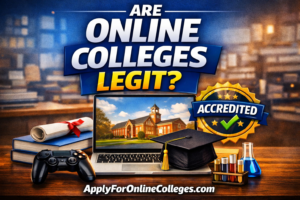
Online education has transformed how students earn degrees, offering flexibility, affordability, and accessibility. Yet one question still lingers for many prospective learners: Are online colleges legit? The short answer is yes — when you choose accredited institutions that meet rigorous academic standards. Let’s explore how to identify legitimate online colleges, what accreditation means, and why employers increasingly value online degrees.
Understanding Accreditation
Accreditation is the key factor that separates legitimate online colleges from diploma mills. In the U.S., recognized accrediting agencies evaluate schools based on curriculum quality, faculty credentials, student outcomes, and institutional integrity.
Legitimate online colleges are accredited by organizations approved by the U.S. Department of Education or the Council for Higher Education Accreditation (CHEA).
When researching programs, look for regional or national accreditation. Regional accreditation is generally considered the gold standard — examples include the Higher Learning Commission (HLC), Middle States Commission on Higher Education, and Southern Association of Colleges and Schools (SACSCOC).
Why Accreditation Matters
Accreditation ensures your degree is recognized by employers, licensing boards, and other universities. Without it, you may face problems transferring credits or qualifying for federal financial aid.
Before enrolling, verify accreditation directly on the school’s website or through the Database of Accredited Postsecondary Institutions and Programs (DAPIP) at https://ope.ed.gov/dapip.
Signs of a Legitimate Online College
Here are key indicators that an online college is credible and trustworthy:
- Accredited by a recognized agency
- Transparent tuition and refund policies
- Professional faculty with verifiable credentials
- Accessible student support services (academic advising, career counseling, tech help)
- Official contact information — physical address, phone number, and email
- Secure website ending in .edu or a verified institutional domain
If a school promises a degree “in weeks” or guarantees employment, that’s a red flag. Legitimate colleges require coursework, exams, and participation — just like traditional universities.
Examples of Accredited Online Colleges
Below are several respected institutions offering fully accredited online programs:
1. Purdue University Global
Address: 2550 Northwestern Ave, West Lafayette, IN 47906
Website: https://www.purdueglobal.edu
Phone: (866) 522‑7747
Email: [email protected]
Purdue Global is regionally accredited and offers flexible online degrees in business, healthcare, and technology. Its programs are designed for working adults seeking career advancement.
2. Southern New Hampshire University (SNHU)
Address: 2500 North River Rd, Manchester, NH 03106
Website: https://www.snhu.edu
Phone: (800) 668‑1249
Email: [email protected]
SNHU is one of the largest accredited online universities in the U.S., known for affordable tuition and strong student support. It offers over 200 online programs.
3. Arizona State University (ASU) Online
Address: 1151 S Forest Ave, Tempe, AZ 85281
Website: https://asuonline.asu.edu
Phone: (866) 277‑6589
Email: [email protected]
ASU Online consistently ranks among the best for innovation and quality. Students earn the same degree as on‑campus peers, with access to world‑class faculty and resources.
4. Liberty University Online
Address: 1971 University Blvd, Lynchburg, VA 24515
Website: https://www.liberty.edu/online
Phone: (800) 424‑9595
Email: [email protected]
Liberty University offers accredited online programs emphasizing academic excellence and ethical leadership. Courses are flexible and designed for adult learners.
5. University of Florida (UF) Online
Address: 1765 Stadium Rd, Gainesville, FL 32611
Website: https://ufonline.ufl.edu
Phone: (352) 392‑1365
Email: [email protected]
UF Online provides nationally ranked programs in business, education, and health sciences. Students earn the same respected degree as traditional UF graduates.
Employer Perception of Online Degrees
A decade ago, some employers were skeptical of online education. Today, that stigma has largely disappeared. Accredited online degrees are now viewed as equal to on‑campus credentials, especially when earned from reputable universities.
Employers value the discipline, time management, and technical skills required to succeed in virtual learning environments.
Advantages of Online Colleges
- Flexibility: Study anytime, anywhere — perfect for working adults.
- Affordability: Lower tuition and no commuting costs.
- Accessibility: Programs available nationwide.
- Career‑Focused Curriculum: Many online colleges design courses aligned with industry needs.
Online learning also fosters digital collaboration and self‑motivation — essential skills in today’s workforce.
Are Online Colleges Legit: How to Avoid Diploma Mills
Diploma mills are unaccredited institutions that sell degrees without legitimate coursework. Protect yourself by verifying accreditation, checking reviews, and contacting the school directly.
If a website lacks a physical address or uses vague contact info, it’s likely not legitimate. Always confirm through official education databases.
Are Online Colleges Legit: Final Thoughts
So, are online colleges legit? Absolutely — when accredited and recognized by the Department of Education. They offer real degrees, respected by employers, and provide flexible pathways to career growth.
Whether you’re pursuing healthcare, business, or technology, online education can open doors to new opportunities.
Explore accredited programs and trusted schools at ApplyForOnlineColleges.com — your guide to legitimate, affordable online learning.