 Best Accredited Online Colleges in 2026: What Accreditation Actually Means
If you’re considering an online degree, one question should come before almost everything else:
Is the college appropriately accredited?
Accreditation can affect financial aid, transferring credits, graduate-school admission, professional licensing and how other institutions view your degree.
Unfortunately, it’s also one of the most confusing parts of choosing an online college.
You’ll see phrases such as:
Institutionally accredited
Programmatically accredited
Recognized accreditor
and sometimes the older phrase:
Regionally accredited
What do they actually mean?
And how can you check whether an online college is genuinely accredited rather than simply trusting the school’s advertising?
Let’s make it much simpler.
What Does College Accreditation Mean?
Accreditation is a process through which an outside accrediting organization evaluates a college, university or particular academic program against established standards.
In the United States, the Department of Education does not directly accredit colleges.
Instead, accrediting organizations carry out accreditation, and the U.S. Department of Education recognizes accrediting agencies that meet its requirements.
The Department maintains information on recognized institutional and programmatic accrediting agencies and provides a database students can use to look up accredited institutions and programs. (U.S. Department of Education)
That’s an important distinction.
A college saying:
“We are accredited.”
isn’t enough information by itself.
You need to know who accredited it.
Why Does Accreditation Matter?
Accreditation can matter for several reasons.
Federal financial aid
Accreditation by an appropriately recognized accrediting agency is an important part of institutional eligibility for federal student-aid programs. (U.S. Department of Education)
Transfer credits
Colleges decide their own transfer policies, but accreditation can affect whether another institution is willing to consider your previous coursework.
Graduate school
If you eventually apply for a master’s or doctoral program, the institution awarding your bachelor’s degree can matter.
Professional licensing
Some careers have specific educational and accreditation requirements for professional licensure.
Employers
Employers may consider whether a degree was awarded by an appropriately accredited institution, particularly in professions where educational credentials are important.
This is why accreditation deserves to be checked before you enroll, not when you’re about to graduate.
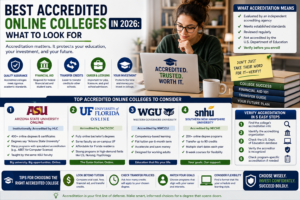
Best Accredited Online Colleges to Consider
There are many appropriately accredited universities offering online degrees.
Rather than pretending there is one objectively “best” college for everyone, here are several established options we’ve encountered repeatedly while researching this series.
Each offers something different.
1. Arizona State University Online
Arizona State University is institutionally accredited by the Higher Learning Commission (HLC), and that accreditation covers its online degree programs through ASU Online. (ASU Online)
ASU Online currently offers more than 400 online degree programs and certificates across undergraduate and graduate study.
One interesting feature is that an online student’s diploma and transcript say Arizona State University rather than identifying the qualification as a separate “ASU Online” degree. (ASU Online)
Why consider ASU Online?
The enormous program selection makes ASU worth investigating for students who want the resources and academic choices of a large public research university.
Some individual programs also hold specialized accreditation.
We’ve already encountered an example in our Best Online Computer Science Degree Programs article, where ASU’s online BS in Computer Science carries ABET accreditation.
Best suited to: Students looking for a large public university with extensive online degree choices.
2. University of Florida Online
The University of Florida is institutionally accredited by the Southern Association of Colleges and Schools Commission on Colleges (SACSCOC).
That accreditation covers the university’s authority to award degrees at multiple levels. (University of Florida Online)
UF Online provides the university’s fully online bachelor’s degree programs.
Why consider UF Online?
For Florida residents in particular, UF Online can combine institutional accreditation with attractive public-university tuition.
We’ve already seen this in our Most Affordable Online Degrees guide.
UF Online also offers bachelor’s degrees in subjects including computer science and psychology, both of which we’ve covered in this series.
Best suited to: Students wanting an online bachelor’s degree from a major public university, particularly Florida residents.
3. Western Governors University
WGU is institutionally accredited by the Northwest Commission on Colleges and Universities (NWCCU). (Western Governors University)
NWCCU is among the institutional accrediting agencies recognized by the U.S. Department of Education. (U.S. Department of Education)
WGU’s institutional accreditation was reaffirmed following its regular accreditation review, with a new seven-year cycle beginning in 2024. (Western Governors University)
Why consider WGU?
WGU operates differently from many traditional universities.
Its competency-based structure allows students to progress by demonstrating mastery, while tuition is generally charged by six-month term rather than simply by individual credit.
That can be particularly attractive to experienced and self-directed adult learners.
We’ve already encountered WGU in our Online MBA Programs With No GMAT and Most Affordable Online Degrees articles.
Best suited to: Independent working adults attracted to competency-based education.
4. Southern New Hampshire University
Southern New Hampshire University is another large university with a substantial online student population and a wide selection of online undergraduate and graduate programs.
SNHU is institutionally accredited by the New England Commission of Higher Education (NECHE).
The university has appeared repeatedly in our research because it combines extensive online degree offerings with policies designed around online and adult students.
Why consider SNHU?
SNHU may be particularly worth comparing if you:
- Have previous college credits
- Need flexible online study
- Want multiple annual start dates
- Want a large choice of degree programs
We’ve already encountered SNHU in our psychology, computer science, MBA, no-SAT and working-adult guides.
Best suited to: Working adults and transfer students wanting a university with extensive online infrastructure.
Is There One “Best” Accredited Online College?
No.
And I wouldn’t trust an article that suggests there is without explaining its criteria.
Consider four different students.
Student A lives in Florida and wants an affordable psychology degree.
UF Online might be an excellent candidate.
Student B wants a highly flexible competency-based business degree.
WGU might suit them better.
Student C wants an online computer science program with ABET accreditation.
ASU becomes particularly interesting.
Student D has accumulated a large number of previous college credits and wants a flexible adult-oriented university.
SNHU might deserve a close look.
All four students are asking for a good accredited online college.
They can reasonably arrive at four different answers.
Institutional vs. Programmatic Accreditation
This distinction is important.
Institutional accreditation
This evaluates the institution as a whole.
For example:
Arizona State University — Higher Learning Commission.
University of Florida — SACSCOC.
Western Governors University — NWCCU.
Programmatic accreditation
This applies to a specific program or professional field.
The Department of Education maintains separate information about recognized programmatic accrediting agencies. (U.S. Department of Education)
Programmatic accreditation can be particularly important in fields such as:
- Engineering
- Nursing
- Education
- Counseling
- Psychology
- Architecture
- Certain health professions
Whether you need it depends on the degree and what you intend to do afterward.
A Good Example: Computer Science
Our recent computer science article gives us an excellent real-world example.
Arizona State University’s online Bachelor of Science in Computer Science is ABET accredited.
ABET evaluates programs in fields including computing and engineering against specialized standards. (ASU Online)
Here you effectively have two levels to consider:
Arizona State University → institutional accreditation
and
The particular computer science program → specialized/programmatic accreditation.
That’s why asking simply:
“Is this university accredited?”
is sometimes only the beginning.
What Happened to “Regional Accreditation”?
For years, students were frequently told to look specifically for regional accreditation.
You’ll still see the phrase on university websites and older college-advice articles.
The terminology used by the U.S. Department of Education now emphasizes institutional accrediting agencies rather than treating “regional” and “national” as the simple dividing line students once encountered.
For practical purposes, don’t rely on an old article telling you merely to “look for regional accreditation.”
Instead ask:
Is the institution accredited by an accrediting agency recognized by the U.S. Department of Education?
Then check whether your particular degree also needs specialized accreditation.
How to Check a College’s Accreditation Yourself
This is something every prospective online student should know how to do.
Step 1: Go to the college’s website
Find its accreditation page.
Step 2: Identify the accrediting organization
Don’t stop at the word “accredited.”
Write down the actual accreditor.
Step 3: Check the U.S. Department of Education
The Department provides a database of accredited postsecondary institutions and programs as reported by accrediting and state approval agencies. (U.S. Department of Education)
Step 4: Check the accreditor
Confirm the accrediting organization itself is appropriately recognized.
Step 5: Investigate your specific degree
If you’re entering a licensed or regulated profession, determine whether the program itself needs specialized accreditation.
Five minutes spent doing this before applying could prevent an extremely expensive mistake.
Beware of Accreditation That Sounds Impressive
Not every organization using words such as:
Accrediting
Academic
International
Education
or
Commission
is necessarily a recognized U.S. higher-education accreditor.
The Department of Education warns students about diploma mills and explains that unrecognized accrediting organizations have not had their accreditation standards reviewed through the Department’s recognition process. (U.S. Department of Education)
A professional-looking website isn’t verification.
Neither is a badge saying “Fully Accredited.”
Check independently.
What Is a Diploma Mill?
A diploma mill generally offers degrees or credentials with little meaningful academic work, often primarily in exchange for payment.
Warning signs can include:
A degree awarded unusually quickly
Large amounts of academic credit based primarily on life experience
Very little coursework
Pressure to pay immediately
Accreditation that can’t be independently verified
Vague or nonexistent faculty information
A name deliberately resembling a well-known university
If something looks too easy to be a genuine bachelor’s, master’s or doctoral degree, investigate further.
Does Accreditation Mean a College Is Excellent?
No.
This is another important distinction.
Accreditation provides a baseline form of external quality review.
It doesn’t mean every accredited university is equally good.
Two appropriately accredited colleges can differ enormously in:
- Tuition
- Graduation rates
- Student support
- Course quality
- Transfer policies
- Career services
- Faculty
- Degree selection
- Flexibility
Think of accreditation as a minimum filter, not the final ranking system.
First verify accreditation.
Then compare the colleges that remain.
Does Accreditation Guarantee Credits Will Transfer?
No.
This is a common misunderstanding.
The receiving university ultimately determines whether it will accept your credits and how those credits apply to a particular degree.
Attending an appropriately accredited institution can help, but there is no universal guarantee that every course will transfer everywhere.
If you already have college credits, request a formal evaluation.
Ask:
How many of my credits will actually apply toward this specific degree?
That question is much more useful than simply asking whether the university “accepts transfer credits.”
Accreditation and Financial Aid
Accreditation also matters when investigating federal financial aid.
Federal Student Aid participation involves institutional eligibility requirements, and accreditation by an appropriately recognized agency is part of that framework. (U.S. Department of Education)
But don’t assume:
Accredited = I personally qualify for aid.
Your own eligibility matters, as does the eligibility of the institution and program.
That’s why we created two separate guides:
Financial Aid for Online Colleges
Online Colleges That Accept FAFSA
Both should be linked from here.
Accreditation and Professional Licensure
This deserves special attention.
Suppose you’re studying for a career that requires a state license.
Examples can include:
- Nursing
- Teaching
- Psychology
- Counseling
- Engineering
- Social work
- Certain healthcare professions
A university being institutionally accredited may not by itself guarantee that a particular degree satisfies licensing requirements in your state.
ASU, for example, specifically advises prospective students to investigate whether a professional licensure program meets requirements in the state where they intend to practice. (ASU Online)
If your intended career requires licensure, work backward:
Career → state licensing requirements → required education → suitable accredited program.
Don’t start with a degree advertisement.
Online Accreditation vs. Campus Accreditation
Students sometimes wonder whether online degrees need some separate type of accreditation.
Generally, you’re investigating the accreditation of the institution and, where relevant, the specific program, rather than looking for a special badge simply because classes are delivered online.
For example, Arizona State University’s HLC institutional accreditation covers its ASU Online programs. (ASU Online)
UF Online’s bachelor’s programs are offered through the University of Florida, which holds SACSCOC institutional accreditation. (University of Florida Online)
The fact that you study remotely doesn’t automatically make the degree a separate institution.
Are Online Degrees Respected?
A legitimate online degree can absolutely come from an established accredited university.
But employers and graduate schools can consider many factors beyond delivery method.
These can include:
- University
- Degree subject
- Relevant experience
- Skills
- Grades
- Professional certifications
- Portfolio
- Internships
- Licensing requirements
Rather than asking:
“Are online degrees respected?”
a better question is:
“Is this particular degree from this particular university appropriate for what I want to do?”
Don’t Choose on Accreditation Alone
Once you’ve verified accreditation, continue comparing.
Ask:
Does the university offer my degree?
What will it cost me to finish?
How many credits will transfer?
Can I get financial aid?
- Does the course format fit my schedule?
- Does the curriculum support my career goal?
- Does my profession require programmatic accreditation or licensure?
- This is where our other guides become useful.
For costs:
Most Affordable Online Degrees
For flexibility:
Best Online Colleges for Working Adults and Parents
For the application process:
How to Apply for Online Colleges
A Simple Five-Minute Accreditation Check
Before applying to any online college:
1. Find the university’s official accreditation page.
2. Write down its institutional accreditor.
3. Verify that accreditor using U.S. Department of Education resources.
4. Search for any specialized accreditation required for your degree.
5. Check licensing requirements if your intended career is regulated.
Do that for every university on your shortlist.
It’s one of the easiest pieces of due diligence you can perform.
Frequently Asked Questions
What are some of the best accredited online colleges?
ASU Online, UF Online, Western Governors University and Southern New Hampshire University are established institutions offering extensive online education. The best choice depends on your degree, budget, transfer credits, schedule and career plans.
How can I tell whether an online college is accredited?
Check the university’s official accreditation information, identify the accrediting agency and verify it through U.S. Department of Education accreditation resources. (U.S. Department of Education)
Does the U.S. Department of Education accredit colleges?
No. Accrediting organizations accredit colleges and programs. The Department recognizes accrediting agencies that meet its recognition requirements. (U.S. Department of Education)
Is institutional accreditation enough?
For many general degrees, institutional accreditation is the primary accreditation consideration. However, certain professional or licensed fields may also require specialized or programmatic accreditation.
Does accreditation guarantee my credits will transfer?
No. The receiving institution decides whether credits transfer and how they apply toward a degree.
Can an accredited online college accept FAFSA?
Accreditation is an important part of federal student-aid institutional eligibility, but students should verify that their particular institution and program participate and that they themselves meet eligibility requirements.
Are online degrees accredited differently?
Not necessarily. Online programs can be offered by the same institution that holds institutional accreditation for its campus programs. Some individual programs may also have specialized accreditation.
Final Thoughts
Choosing among the best accredited online colleges doesn’t mean finding one university that’s supposedly best for everyone.
It means beginning with a group of appropriately accredited institutions and finding the one that best matches your goal.
ASU Online offers a huge selection of programs through a major public university.
UF Online can be particularly attractive to students looking for online bachelor’s degrees and, for Florida residents, potentially very competitive tuition.
WGU offers a distinctive competency-based model for independent adult learners.
SNHU provides a large online infrastructure with extensive degree choices and transfer opportunities.
But the college name is only part of the decision.
Verify accreditation independently.
Check whether your particular degree requires specialized accreditation.
Investigate licensing requirements where relevant.
Then compare cost, transfer credits, financial aid, flexibility and curriculum.
Accreditation tells you where to begin your comparison.
It shouldn’t be where the comparison ends.