 Online MBA Programs with No GMAT Required in 2026
Earning an MBA used to mean that taking the GMAT was almost an automatic part of the application process.
That’s no longer always the case.
A growing number of universities offer online MBA programs with no GMAT requirement, making graduate business education more accessible to working professionals who don’t want to spend months preparing for a standardized admissions test.
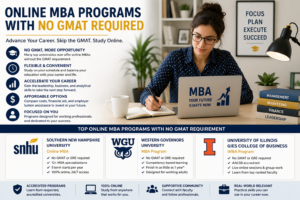
Southern New Hampshire University, Western Governors University and the University of Illinois Gies College of Business are examples of universities currently offering online MBA pathways where the GMAT isn’t required for admission. (Southern New Hampshire University)
However, no GMAT does not mean no admission requirements.
Universities may instead consider your bachelor’s degree, academic history, professional experience, résumé, essays or other evidence that you’re prepared for graduate-level business study.
Here’s what to know when comparing online MBA programs with no GMAT in 2026.
Why Are Some MBA Programs Dropping the GMAT?
The GMAT was traditionally used by business schools as one way to assess whether applicants were prepared for graduate business education.
But universities increasingly recognize that one standardized test isn’t the only way to evaluate an applicant.
This can be especially relevant to working adults.
Someone who has spent ten years managing employees, budgets or projects may have substantial evidence of professional ability that doesn’t appear on a standardized test.
SNHU, for example, says eliminating the GMAT allows it to focus more on an applicant’s academic background and readiness and can remove a barrier for working adults. (Southern New Hampshire University)
Skipping the GMAT can also save applicants the time and expense associated with preparing for and taking the examination.
1. Southern New Hampshire University
Southern New Hampshire University offers an online MBA without requiring the GMAT or GRE.
SNHU currently offers more than a dozen specialized MBA options and five graduate term starts per year. Its online graduate coursework is available around the clock, which can be particularly useful for employed students. (Southern New Hampshire University)
Why consider SNHU?
The combination of no GMAT, multiple start dates and online access makes SNHU particularly worth investigating for working professionals.
Students can also choose MBA concentrations rather than being limited to a general MBA.
Best suited to: Working adults looking for a structured online MBA with multiple specialization options.
2. Western Governors University
Western Governors University is another clear no-GMAT option.
WGU explicitly states that applicants to its MBA do not need to take either the GRE or GMAT. MBA applicants generally need to submit transcripts verifying a qualifying bachelor’s, master’s or doctoral degree from a recognized accredited institution. (Western Governors University)
WGU also uses a competency-based educational model.
Rather than relying solely on a traditional semester structure, students progress by demonstrating mastery of required material.
Why consider WGU?
That model may appeal particularly to experienced professionals who are comfortable studying independently and managing their own progress.
It won’t necessarily suit everybody.
Students who prefer regular weekly classes and a highly traditional schedule may prefer another program.
Best suited to: Independent and self-motivated working professionals.
3. University of Illinois Gies College of Business iMBA
The University of Illinois Urbana-Champaign’s Gies College of Business offers its MBA online through the iMBA program.
Gies currently states that a GMAT or GRE score isn’t required for admission. Applicants may choose to submit a score, but aren’t penalized for not doing so. The iMBA is also AACSB accredited. (Gies Online | Gies College of Business)
There is an important distinction here.
The program combines asynchronous learning with high-engagement components that include weekly live sessions, group work and faculty-graded assignments. (Gies Online | Gies College of Business)
So although the program is online, students shouldn’t assume it means completely independent study whenever they want.
Why consider Illinois?
For students who want interaction and scheduled engagement rather than an entirely self-paced experience, that structure may actually be an advantage.
Best suited to: Professionals wanting an online MBA from a major public research university and who value interaction with faculty and classmates.
4. Other No-GMAT and GMAT-Waiver Programs
You’ll encounter two slightly different phrases when researching MBA programs:
No GMAT required
and
GMAT waiver available
They don’t necessarily mean the same thing.
A university that requires no GMAT has removed the examination from its standard admissions requirements.
A GMAT waiver may mean you can avoid the examination only if you satisfy particular criteria.
Arizona State University Online, for example, says many of its graduate programs don’t require a GRE or GMAT, while GMAT waivers are available for many others on a case-by-case basis. (ASU Online)
Always check the admissions page for the specific MBA program you’re considering.
Don’t rely on a general statement that a university offers “test-optional graduate admissions.”
Does No GMAT Mean the MBA Is Easier?
No.
Removing an admissions examination doesn’t automatically change the academic standards of the degree itself.
You may still study subjects such as:
- Accounting
- Finance
- Marketing
- Economics
- Leadership
- Operations
- Strategy
- Data and analytics
- Organizational behavior
You’ll still need to complete the required assignments, assessments and other academic work.
Think of “no GMAT” as an admissions feature, not an indication of an easier degree.
Is an Online MBA Without GMAT Respected?
The absence of a GMAT requirement isn’t the first thing I’d use to judge an MBA.
Instead, investigate the university and program.
Questions worth asking include:
Is the university appropriately accredited?
Does the business school have relevant programmatic accreditation?
What does the curriculum contain?
Who teaches the courses?
How much will the entire MBA cost?
What support is available to online students?
Does the format fit my career and schedule?
A respected university doesn’t suddenly become illegitimate because it stops requiring a standardized admissions test.
Accreditation Matters
Accreditation should be one of your first checks when comparing online MBA programs.
Institutional accreditation provides an important indication that the university has been evaluated against established educational standards.
Business schools may also hold specialized accreditation.
The University of Illinois Gies iMBA, for example, identifies itself as AACSB accredited. (Gies Online | Gies College of Business)
Don’t choose an MBA simply because its admission process looks easy.
A five-minute application and no GMAT may sound attractive, but the long-term value of the qualification matters much more than the convenience of getting admitted.
How Much Does an Online MBA Cost?
Costs vary dramatically.
Don’t compare programs using only the price of a single course or credit hour.
Instead calculate:
Tuition for the entire program
plus
Mandatory fees
plus
Books/materials
minus
Grants, scholarships and employer assistance
equals a much more useful estimate of your real MBA cost.
Also consider how long you’ll take to finish.
An inexpensive MBA that requires you to reduce your working hours may have a hidden economic cost that isn’t shown on the tuition page.
Can You Get Financial Aid for an Online MBA?
Eligible graduate students attending eligible institutions and programs may have access to federal student aid and other forms of financial assistance.
However, graduate-level financial aid differs from undergraduate aid in important ways.
For example, Pell Grants are generally aimed at eligible undergraduate students rather than students pursuing an MBA.
Graduate students should investigate federal loans, scholarships, employer tuition assistance and aid offered directly by the university.
Check With Your Employer Before Paying
This is especially important for MBA students.
Some employers provide tuition reimbursement or educational assistance for employees pursuing business-related graduate degrees.
Before enrolling, ask your HR department whether your employer offers:
Tuition reimbursement
Tuition assistance
University partnerships
Scholarships
or
Professional-development funding
Also check whether accepting the money creates an obligation to remain with the company for a particular period.
An employer contribution could substantially change which MBA provides the best value.
Online MBA vs. Traditional MBA
Online and campus MBA programs can cover similar academic material, but the experience can be very different.
A traditional MBA may provide more face-to-face interaction and campus networking.
An online MBA can allow students to remain employed and avoid relocating.
For an established professional with a job, family and mortgage, the ability to keep earning an income while studying can be extremely important.
For someone early in their career who wants an immersive business-school experience and intensive in-person networking, a traditional program might be more attractive.
Neither format is automatically better.
The right choice depends on what you’re trying to achieve.
Should You Choose a General MBA or a Specialization?
Many universities offer both.
Possible MBA concentrations can include:
Finance
Marketing
Healthcare administration
Human resources
Project management
Accounting
Business analytics
Entrepreneurship
A specialization may make sense when you already know the field in which you want to advance.
A general MBA may provide broader business education and allow greater flexibility.
Don’t choose a specialization simply because its title sounds impressive.
Look at the actual courses.
How Long Does an Online MBA Take?
It varies considerably.
Your completion time can depend on:
- Number of required credits
- Course length
- Number of courses taken at once
- Program structure
- Whether you take breaks
- Your ability to progress through competency-based coursework
SNHU says its master’s degrees can be completed in as few as 15 months, while WGU promotes the possibility of completing its MBA in approximately one year for students able to progress quickly. These are possibilities rather than promises of how long an individual student will take. (Southern New Hampshire University)
Never select an MBA solely because of an advertised “finish in X months” message.
Ask yourself whether that pace is realistic alongside your job and family.
What Are the Admission Requirements Without a GMAT?
This varies by school.
A no-GMAT MBA might still require:
A bachelor’s degree
Official transcripts
Minimum GPA
Professional résumé
Work experience
Personal statement or essay
Recommendations
English-language proficiency for applicable international applicants
Some programs have relatively simple admission processes, while others conduct a more extensive review.
No GMAT doesn’t mean automatic admission.
Is an MBA Worth It?
That’s a more complicated question than advertisements sometimes suggest.
An MBA can make sense when it supports a specific career objective—for example, moving into management, changing business functions or developing skills needed for advancement.
But an MBA also costs money and time.
Before enrolling, ask:
What do I expect this MBA to help me accomplish that I can’t reasonably accomplish without it?
Then investigate whether graduates in your intended field actually need or benefit from the qualification.
The answer may be yes.
But deciding that before borrowing thousands of dollars is considerably better than discovering it afterward.
Five Questions to Ask Every MBA Program
Before applying, get clear answers to these:
1. Is the GMAT genuinely not required, or do I need a waiver?
2. What is the total expected cost of completing the MBA?
3. Is the university appropriately accredited?
4. Are there scheduled live sessions, or can I study asynchronously?
5. What career outcome am I trying to achieve with this degree?
Those five questions will eliminate many unsuitable options surprisingly quickly.
Frequently Asked Questions
Can you get an MBA online without taking the GMAT?
Yes. Universities including SNHU, WGU and the University of Illinois Gies College of Business currently offer online MBA programs where the GMAT isn’t required for admission. (Southern New Hampshire University)
Are no-GMAT MBA programs legitimate?
They can be. A GMAT requirement isn’t what determines whether an MBA is legitimate. Investigate institutional accreditation, business-school accreditation where applicable, curriculum and the university itself.
Does WGU require the GMAT for its MBA?
No. WGU currently states that neither the GRE nor GMAT is required for admission to its MBA. (Western Governors University)
Does SNHU require the GMAT for its online MBA?
No. SNHU currently advertises its online MBA without a GMAT requirement. (Southern New Hampshire University)
Does the University of Illinois iMBA require GMAT scores?
No. Gies states that GMAT and GRE scores aren’t required. Applicants may optionally submit scores. (Gies Online | Gies College of Business)
Is a no-GMAT MBA easier than a regular MBA?
Not necessarily. The GMAT relates to admission. Students still have to meet the academic requirements necessary to earn the MBA.
Final Thoughts
Online MBA programs with no GMAT requirement can remove a significant obstacle for working professionals interested in graduate business education.
SNHU provides a flexible online option with multiple MBA specializations. WGU offers competency-based education that may appeal to independent learners. The University of Illinois Gies iMBA provides another approach with online learning combined with substantial interaction.
But don’t make “no GMAT” your main reason for choosing an MBA.
Compare accreditation, curriculum, total cost, flexibility and how well the degree supports your actual career objective.
The easiest MBA to enter isn’t necessarily the best MBA to earn.
Choose the program based on where you want it to take you—not simply on which admission test you can avoid.